Showing posts with label Astronomy. Show all posts

Wednesday, December 21, 2011

Kemble's Cascade

This is the second of two groups of stars with interesting patterns I saw around the winter solstice. Had to wear three layers of pants, four layers of tops, a scarf, a cap and ear muffs to fend off the sub-zero temperature.

This group of stars is known as Kemble's Cascade, named after a Canadian friar from Saskatchewan. More information from NASA here. It's really quite pretty through the telescope, looking like stars tumbling down a stream.

A sketch on GIMP 2 (note that the entire chain took up at roughly 3 fields of view through my eyepiece):
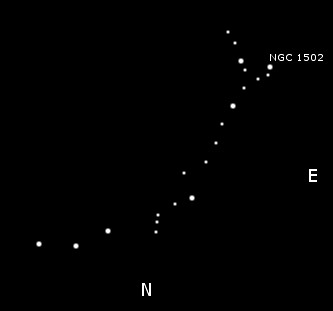


Kemble's Cascade includes an open star cluster designated NGC 1502. Although with the limited resolving power of my telescope I could only make it out as a rather bright star (top right of the sketch).

A star cluster is a group of stars that are bound together by gravity. You might say that the attraction is mutual.

On the other hand, the entire chain of stars along the cascade is not gravitationally-bound. They look like they form a chain but in actual fact are probably millions of light years away from one another. Such fortuitous associations are known as asterisms.

To put it another way, you stand in front of a tree and see the moon above your neighbour's satellite dish across the street. The moon may look like it's hovering 2 feet above the dish but you know they're a few million miles apart.

It's all about perspective.

To locate Kemble's Cascade, see the sketch below:
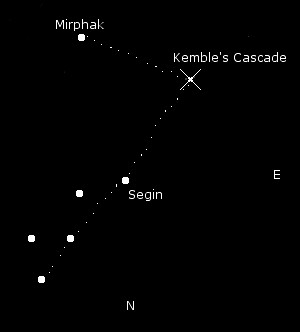


First find Mirphak, our star in Perseus featured in my previous post. Then look for the M-shaped constellation Cassiopeia. Kemble's Cascade roughly forms a right angle triangle with Mirphak and Segin, the star making the right foot of the M.

Tuesday, December 20, 2011

The alpha Persei association

Had a very clear sky tonight and decided to do some casual observation before flying back to Singapore.

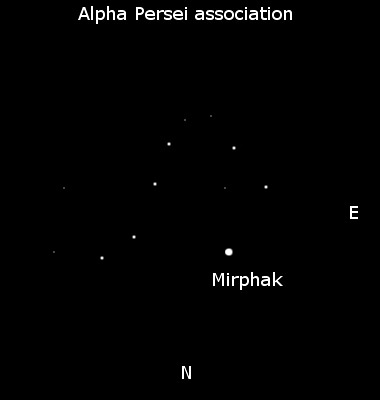
Looking north, almost at the zenith and in line with the meridian was the constellation Perseus. Through a 70mm refractor at 20x I was able to make out an interesting chain of stars around Mirphak or alpha Persei, the lead star of the constellation. It's an interesting chain snaking, as if dancing, around Mirphak.

I made a sketch on GIMP 2 here:


Although skies were clear, light pollution was really bad. Bortle Scale of 9, bright inner-city lights with Hongqiao airport less than 5km away and its runway lights blasting up to the north of where I was. There're definitely more stars in this chain and I could only catch a hint of them with averted vision. The Pole Star was barely visible.

More on star associations and this particular one here:

http://www.cloudynights.com/item.php?item_id=2565

More on Perseus the next time.

Saturday, December 22, 2007

Winter solstice

So once again we are at the turning point of the year. The northern hemisphere is experiencing its longest night. The winter solstice falls on the thirteenth day of the eleventh month of the Chinese calendar (十一月十三日) this year.

It's strange that I should remember and mark this astronomical event every year. The quietness of a dark night appeals to me more than the noise and light of other occasions like Christmas or Chinese New Year. I can imagine a family reunited for dinner on the longest night of the year.


Image credit: baidu.com

Of course, it's quite nonsensical to talk about a long, dark winter's night while I live right smack on the Equator where the climate is perpetually hot and humid. Maybe that's why I find it mind-numbingly stifling here. The weather is a metaphor of the mindset here in 1984-ville. Every where I turn to, people go to the same malls for leisure. Everyone lives in perpetual fear of losing their jobs, or of not getting their yearly bonus. The conversation topics revolve around property prices, public and private transport taxes. The weather is hot, humid and nothing else. We wear the same kinds of clothes the whole year round. And every household overworks its System 4 Inverters.

Nobody looks up at the sky anymore. We are losing our individual and collective souls. When was the last time you saw a shooting star? Really...

Pause and think about what it means to be in-sync with your inner soul as you go about completing the last-minute shopping. What is it to be human?

I wish you peace.

Thursday, September 20, 2007

The beginning and end of summer


Source: The Internet Encyclopedia of Science


The Sun crosses the Equator in a few days' time on its southward journey. September 23rd to be precise. Actually, to be strictly correct, the Sun doesn't cross the Equator. It's more like the Earth reaching a portion of her orbit around the Sun such that parts of the Earth's surface around the Equatorial region would face the Sun directly at noon on September 23rd. Those who spoke Latin named this day Equinox, from aequus (equal), nox (night), meaning there would be equal number of day and night hours in a single day.

In another three months the Chinese will be celebrating the end of another year. They call that winter solstice in the northern hemisphere. Longer nights ahead.

Of course, things are reversed in the southern hemisphere.

On a more practical side, it also means that the sun will no longer shine directly into my living room. Cooler daytime temperatures are definitely welcomed.

_______________

Sunday, March 18, 2007

How to lower your air-con bill


Source: Google

The weather's slowly turning hot again, with the passing of February (usually the wettest month of the year). Soon the Sun will cross the Equator (22nd March) on it's journey north, this means direct sunshine into the apartment.

Trouble is, I don't have air-con. So how?

Good thing is, the neighbour living in the unit directly under mine has a habit of turning his air-con up full blast. Sometimes it feels like I'm walking on a sheet of ice.

Guess I could lie on the floor on those warm days...

Friday, December 22, 2006

Winter solstice


Source: Google

Popularly known as 冬至 among the Chinese community. Legend has it that the birth date of Jesus was moved to 25th December to coincide with winter solstice - the shortest day, after which the sun was "reborn" and daylight hours become longer.

The marking of 冬至 as a holiday was recorded as far back as the Spring-Autumn (春秋) Period (722-481 BC). The Book of Later Han (后汉书) records, "冬至前后,君子安身静体,百官绝事,不听政,择吉辰而后省事." Roughly translated as, "the time around 冬至, the emperor rested and calmed his body, the imperial palace refused to work, the imperial sessions ceased, auspicious dates were selected."

So the concept of "clear leave" is not that modern after all. However, unlike modern workaholics, the annual leave was mandated and presumably enforced. Imagine being forced to go on leave on the pain of death or torture, or bosses being put under the guillotine for not letting staff go on leave!