So maybe Google has decided to show some spine and walk away from a potentially lucrative market?
Read this article.
Everyone's talking China these days.
Censored search engine is an oxymoron anyway. So maybe Google might just salvage some pride with this move.
Showing posts with label Politics. Show all posts
Showing posts with label Politics. Show all posts
Wednesday, January 13, 2010


Tuesday, April 08, 2008
The sweeping tide

Australia got the ball rolling before 2008 when it booted out the incumbent government in November 2007 and welcomed Kevin Rudd, a Mandarin-speaking former diplomat to China, as the new Prime Minister. The tide of change has not stopped since and democracies, real or otherwise, across the world saw sweeping changes in their governments.
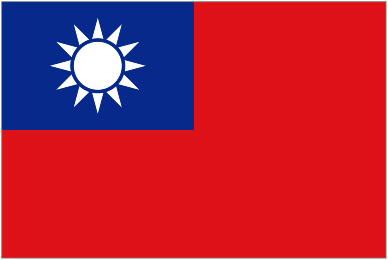
Taiwan was next with the opposition Kuomintang (KMT) coming home to a landslide over the Democratic People's Party (DPP) in the Legislative Yuan, or Assembly, elections, held in January 2008. The DPP, in power since 2000, is led by outgoing President Chan Shui-bian, who has the habit using off-coloured phrases occasionally. The change in government was completed when Ma Ying-jeou of the KMT thrashed Frank Hsieh of the DPP in Presidential elections two months later.

Pakistan took its turn on the political centre stage when, in February, the PMLQ party of President Pevez Musharraf was almost booted out of the legislative body by the Pakistan People's Party (PPP), formerly headed by the recently-assasinated Benazir Bhutto. It's ironic that Musharraf was described by George Bush as his friend and ally because Musharraf came to power through a 1999 military coup and had sacked and jailed most of the independent judiciary in Pakistan, especially after the former Chief Justice Iftikhar Chaudhry declared the continued Presidency of Musharraf unconstitutional. Well, the good news is that Chaudhry has been freed and reinstatement is pending approval by the PPP government.
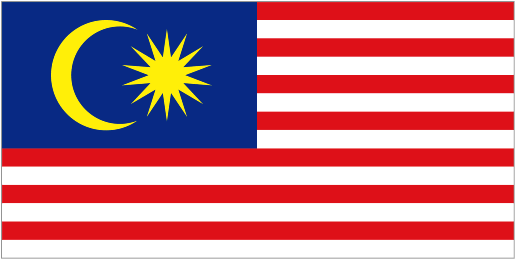
Political action then moved to Malaysia, where the seemingly strong National Front government of Abdullah Badawi was embarrased by a hotch-potch of small opposition parties, independents and a political blogger, which not only denied the NF a two-thirds majority in the federal legislative, Dewan Rakyat, (Lower House of Parliament) for the first time since independence in 1957, but also grabbed 5 State governments out of 12. Abdullah's position in his own party is under severe scrutiny. With internal party elections coming up later this year, there is an ever-growing call for his blood. However the most anticipated outcome of this watershed election is the return of former Deputy Prime Minister, Anwar Ibrahim, who was arbitrarily removed from power and jailed after a very pubic spat with former PM Mahathir over the handling of the 1997 Asian financial crisis. In fact, this election was called early because Anwar remained ineligible to contest for a certain period of time after release from jail. Anwar's wife has said she will step down from her seat in parliament to create a by-election for Anwar after he becomes eligible to contest.
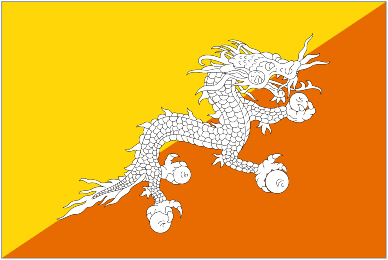
From the hot and humid tropics, the world's attention turned to the isolated Himalayan Kingdom of Bhutan, the land of the Thunder Dragon. The King of Bhutan called for a change from absolute monarchy to democracy. This despite having the respect and admiration of most Bhutanese. Sometimes one really wonders if this really is the benevolent ruler found only in fiction. This is the very same king who imposed a total smoking ban in the country. And he ordered the statisticians to measure the progress of the people in terms of a "happiness index" instead of per capita income, GDP or other traditional methods of economic progress. Shangri-La, anyone?
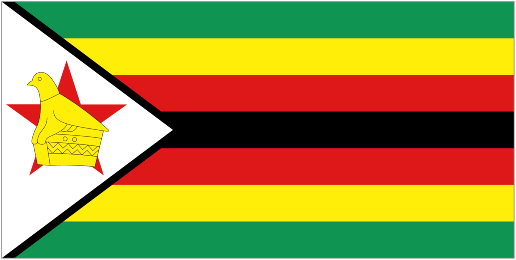
Zimbabwe came up for the electoral process next on 29 March. Unfortunately, Robert Mugabe, the incumbent president, and his Zimbabwe African National Union - Patriotic Front government (Zanu-PF), in power since independence in 1980, has decided not to release the results of elections. As of the time of this writing, Zimbabweans are still awaiting official results to the legislative and presidential offices. Informal results collated by the oppostion Movement for Democractic Change (MDC) has indicated opposition wins in both. The police authority, no doubt controlled closely by Zanu-PF, has physically stopped MDC lawyers from going to the courts to petition for the release of official results. One can only wonder how long more Mugabe and his party wish to hang on to power.
Up next? South Korea, Nepal, Italy, Serbia, Cambodia, New Zealand and the big one - the United States, where the Most Powerful Person in the World could be a black or a woman.

Source: www.orstudents.org
Source of all flag images: www.flags.net
For once, the action-packed news does not involve men chasing or hitting a ball, running around a rubber mat, pounding one another to bits, driving noisy, climate-changing cars at 300mph or trying to grab some stupid flame torch making its way around the world.
Oh, and to dictators around thew world, I hope you sleep well tonight...
Monday, March 31, 2008
Things and stuff
It's been rather crazy over the last 6 weeks, getting swamped with work, mostly resulting from workplace incompetency and breaching of job scope. The work culture in 1984-ville is very bad. There is no effective legislation protecting employees and everyone is expected to work beyond 40 hours a week in addition to doing things that are outside of the job scope. Employers often use this culture to slip sneaky clauses into the terms of employment. Things like "...and any other matters that the employer may require the employee to perform." Clauses like that effectively give employers unfair advantage and make employees' job scope arbitrary. And employee-employer contracts are largely unregulated by legislation, so they are essentially private agreements between two parties, meaning the outcomes of disputes are decided in civil courts.

Photo: Alemeda Labor Council
Almost all of my colleagues accept this unfair and unequal labour relationship, perhaps for fear of breaking their rice bowl (or bread basket, if you aren't into rice). Anyone agitating for an improvement in work conditions is seen as rocking the boat. The thing is, employer-employee relationship is really very simple. In any industrial relation, you have three main components - employer, employee and government. With knowledge, you'll have a better idea of what you're getting yourself into before you sign on the dotted line.
Let's take a look at each party of a typical industrial relation in the modern world.

Public Domain
The employee is someone who performs work for an employer. The employee gets certain benefits and returns for performing this work, usually in the form of an agreed amount of money from the employer. There may be other forms of benefits like healthcare, paid leave from work etc. The nature and amount work as well as the benefits in return for work are usually laid out in the form of an agreement, or contract that is mutually agreed upon by both employee and employer. In an ideal situation, the employee would seek maximal benefits for a well-defined set of work or services rendered.
Source: sparklette.net
The employer is usually, but not always, an organization. The employer could also be a person. For example, I may get someone to chaffeur me around instead of driving the car myself. And in return for driving me around, I pay this person a certain amount of money every month. So in this example, the chaffeur is the employee while I am the employer. We see that the main concern for employers is maximal work done at minimal cost. Using the above example, I would, ideally, pay him a buck and have him on 24/7 stand-by, plus car wash & wax every morning. Now, some of you might be sniggering because although I've cited an extreme case, it sounds familiar enough.
Source: Eugene Wallingford
The role of the government in labour relations is to look after the welfare of the people it governs while allowing society to function without hinderance. Of course, the government has certain powers vested to create and enforce legislation on workplace relations. We will immediately realise that it is in the interest of both employees and employers to get the government "on their side". The main concern of any elected government is how it can stay in power. This concern does not apply to governments that do not have to account to its people (i.e. absolute monarchs, dictators, despots, election-riggers etc). Accountable governments, therefore, will strive to create an environment where employee rights are resepected, implement generous (i.e. low) corporate tax policies and have enough in its pockets to fund everyday running of the state so that everyone's happy and will vote for it in the next elections.
We'll look at employment contracts next...
We'll look at employment contracts next...
Wednesday, February 13, 2008
Change (or not)
So we're all waiting with bated breath. While the global balance of power slowly shifts from the West to BRICs, we may see a non-White or female assuming the mantle of Most Powerful Person in the world.

Source: seattlepi.com
Land of the Free and Home of the Brave.
Indeed...
Source: seattlepi.com
Land of the Free and Home of the Brave.
Indeed...
Tuesday, January 08, 2008
Western rubble = Eastern treasure
"Niemand hat die Absicht, eine Mauer zu errichten!"
"No one has the intention to erect a wall!"
-Walter Ulbricht, leader of East Germany
June 15, 1961
Two months before construction of the Berlin Wall
"No one has the intention to erect a wall!"
-Walter Ulbricht, leader of East Germany
June 15, 1961
Two months before construction of the Berlin Wall
So 1984-ville has decided to install a piece of the Berlin Wall in one of its parks. It wasn't that long ago that Communism in Eastern Europe came to an end, along with it the Cold War and oppression of the common man. The Berlin Wall became a symbol of this oppression.
Erected in August 1961 by the East German communist government, under pressure from the Soviet Union, to stem the tide of defectors crossing into West Germany, it came to signify the attempt by rulers to control the ruled, keeping freedom out and forming the fences of a literal and figurative prison. An explicit shoot-to-kill policy was adopted by the East German government on anyone trying to flee westward and about 200 East Germans are known to have died for a chance at freedom.

A piece of history? Maybe. But art? Blood was shed over it. It is a symbol of how badly human beings treat one another. Communism as a political system might be in disfavour now but the threats to freedom remain. When you see kids skateboard past the wall, tell them about the blood and tears that used to bathe it.
Lest we forget.
Sunday, November 18, 2007
ASEAN Summit
and the propaganda machine is in full swing, enlisting Stefanie Sun to sing praises about it, while the purge of Burmese monks continues.
Friday, November 16, 2007
Death penalty
So the UN General Assembly voted 99-52 for the adoption of a non-binding resolution calling for a moratorium on the death penalty. This moratorium was adopted with a view on the eventual abolition of the death penalty as a form of criminal justice. Thirty-odd other countries abstained.
1984-ville, not surprisingly, voted against the adoption of this resolution. In fact, some news wires reported that the UN representative of 1984-ville led the group of 52 nations who voted nay.
A 99-52 margin is not even close. In fact, it's almost 66-33 in terms of percentages. In any electoral process, that wide a margin is considered a thrashing. To put it in context, the Prime Minister of 1984-ville, considered one of the more popular MPs, barely achieved that kind of margin in his own constituency a year ago.
Which begs the question: Is 1984-ville a pariah state?
Hardly. That's because the United States government is a firm supporter of the death penalty. But then again, one could argue that a post-9/11 US is a pariah in the world community.
Progress in this area is slow. Like the abolition of slavery, apartheid and other such things, changes take time. The hangman's (or firing squad, lethal injection etc) count will continue to increase until humanity finally sees the light. But given the sad state of human affairs, I'm not optimistic.
Update: Here is the BBC report. And it quotes the 1984-ville UN representative, "They (countries that voted for) claim to support freedom of expression, but vote to deny it to others." Since when was the death penalty a form of expression that needed protection?
1984-ville, not surprisingly, voted against the adoption of this resolution. In fact, some news wires reported that the UN representative of 1984-ville led the group of 52 nations who voted nay.
A 99-52 margin is not even close. In fact, it's almost 66-33 in terms of percentages. In any electoral process, that wide a margin is considered a thrashing. To put it in context, the Prime Minister of 1984-ville, considered one of the more popular MPs, barely achieved that kind of margin in his own constituency a year ago.
Which begs the question: Is 1984-ville a pariah state?
Hardly. That's because the United States government is a firm supporter of the death penalty. But then again, one could argue that a post-9/11 US is a pariah in the world community.
Progress in this area is slow. Like the abolition of slavery, apartheid and other such things, changes take time. The hangman's (or firing squad, lethal injection etc) count will continue to increase until humanity finally sees the light. But given the sad state of human affairs, I'm not optimistic.
Update: Here is the BBC report. And it quotes the 1984-ville UN representative, "They (countries that voted for) claim to support freedom of expression, but vote to deny it to others." Since when was the death penalty a form of expression that needed protection?
Friday, October 05, 2007
Military junta 2, Burmese people 0

Source: www.irrawaddy.org
It's a sickening feeling. First 1988, then 2007.
The BBC World Service was dissecting the failure of street protests in bringing about immediate political change. One analyst was predicting that future protests might see more violence coming from the people because of the realization that the military regime understands only the language of violence. The response from a Burmese exile was that violence would breed more bloodshed and peaceful demonstrations are far more powerful methods.
It is a sickening feeling indeed. How many more peaceful Burmese need perish before a change happens.
And what next, if the military junta falls?
Sunday, September 30, 2007
More casualties in Burma

Source: The Irrawaddy
The Irrawaddy is an online news source about political happenings in Burma. It's maintained, presumably, by people who are pro-democracy & freedom. The website was disabled by a Trojan-type virus over the past 2 days. I wonder who'd do that?
___________
 burma
burma protest
Saturday, September 29, 2007
Shot in cold blood
Video footage on the website Democratic Voice of Burma appears to show the Japanese journalist, Kenji Nagai, being shot deliberately at close range by soldiers of the Burmese military.
_____________________
burma
protest
_____________________
burmaprotest
Friday, September 28, 2007
Another martyr for journalism


Tense situation in Burma

Source: dathana.blogspot.com
We are all hoping the current situation in Burma would not be a repeat of 1988. Dictatorship and oppression must go. The Burmese people have been under an iron hand for too long. I'm looking forward to the day when people there would be free to sit in front of their own homes, to see their children play in the yard.
This blog has news & photos of the unfolding events as well as links to other blogs monitoring the situation in Rangoon and other cities across the country. Please help spread the news online so that more people become aware of this. If possible, please provide anonymous proxy links to these courageous bloggers because the military junta has blocked access to sites like Blogspot from within Burma.
_________________________
burmaprotestSunday, September 16, 2007
gagging them early

Source: Google imagine search
So this overworked person in my company wrote to the press, complaining about tough conditions in the industry. Unfortunately the local propaganda rag does not publish anonymous letters.
The resulting manhunt and inquisition was a phenomenon to behold, with the deputy CEO and department heads going berserk.
So much for encouraging independent thought...
Wednesday, April 04, 2007
Alan Johnston
Source: gilesbooth
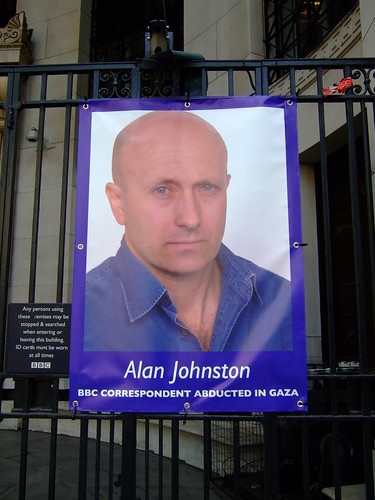
It's been more than 3 weeks since BBC Correspondent Alan Johnston disappeared in the Gaza Strip. Let's hope he gets released soon. You may be wondering why I choose to make a note of his disappearance and not of others. That's because of a certain fondness I have of BCC broadcasts. Growing up with a Mandarin-speaking family, BBC radio transmissions at 88.9FM was a major influence on my English language proficiency. Not only that, they accompanied me through lonely teenage moments and became a window through which I could see the world.
Here are some more details on the abduction of Alan Johnston:
Reporters sans frontieres
BBC
I've started a timer in the side-bar, under "Media links", to track the number of days since his abduction. Let's hope cooler heads prevail.
_________________
Thursday, November 24, 2005
The Burmese enigma (Part 2)
1. Part 1
Well, ever since the Nyugen case erupted, I've been reading more about the illicit drug trade. Apparently most of it that pass through this region originates from what's known as the 'Golden Triangle' area around the borders of Burma, Thailand and Laos.

Image from BBC online
Here is an interesting story from The Australian about Singapore's trade relationship with the military junta in Burma, which is apparently profitting from the drugs trade.
Here is another take on the illicit drug trade in the Golden Triangle. It was an interview given by Adrian Cowell, a British filmmaker who ventured into the area during the 1960s.
Excerpts:
"...I think when the revolutionaries [Burmese revolutionaries fighting the regime at that time] started with opium, they were all idealists, and they did not want to have anything to do with opium...They now are inevitably taxing opium, because actually it's a major source of income for them, and they cannot survive without taxing it....And gradually, as opium dominates your taxation system and your military system more and more, that begins to twist what you're fighting for and who you are. And it's a dangerous thing. It's like any source of finance..."
"...Opium has been a medicine used by their societies and cultures for thousands of years....So that we have banned it here, they regarded it as normal. Heroin only really started to be taken by the people there in the seventies, but it wasn't widely spread. But in the eighties it became very widely spread, and they can see themselves destroying their own society with heroin..."
So idealists start out with the noble aim of fighting for autonomy end up being corrupted by big money.
I end with a quote from Aung San Suu Kyi, the Nobel peace prize laureate whom I admire...
It is not power that corrupts but fear. Fear of losing power corrupts those who wield it and fear of the scourge of power corrupts those who are subject to it.
Technorati tags: Golden Triangle, Opium, Heroin
Well, ever since the Nyugen case erupted, I've been reading more about the illicit drug trade. Apparently most of it that pass through this region originates from what's known as the 'Golden Triangle' area around the borders of Burma, Thailand and Laos.
Image from BBC online
Here is an interesting story from The Australian about Singapore's trade relationship with the military junta in Burma, which is apparently profitting from the drugs trade.
Here is another take on the illicit drug trade in the Golden Triangle. It was an interview given by Adrian Cowell, a British filmmaker who ventured into the area during the 1960s.
Excerpts:
"...I think when the revolutionaries [Burmese revolutionaries fighting the regime at that time] started with opium, they were all idealists, and they did not want to have anything to do with opium...They now are inevitably taxing opium, because actually it's a major source of income for them, and they cannot survive without taxing it....And gradually, as opium dominates your taxation system and your military system more and more, that begins to twist what you're fighting for and who you are. And it's a dangerous thing. It's like any source of finance..."
"...Opium has been a medicine used by their societies and cultures for thousands of years....So that we have banned it here, they regarded it as normal. Heroin only really started to be taken by the people there in the seventies, but it wasn't widely spread. But in the eighties it became very widely spread, and they can see themselves destroying their own society with heroin..."
So idealists start out with the noble aim of fighting for autonomy end up being corrupted by big money.
I end with a quote from Aung San Suu Kyi, the Nobel peace prize laureate whom I admire...
It is not power that corrupts but fear. Fear of losing power corrupts those who wield it and fear of the scourge of power corrupts those who are subject to it.
Technorati tags: Golden Triangle, Opium, Heroin
Tuesday, November 22, 2005
The Burmese enigma

Photo from BBC online report
The BBC reports an unexplained move by the military junta in Burma:
"Burma's confirmation that it was shifting its seat of government has left many analysts at a loss to explain the move..."
Link
Burma moved its capital from Rangoon to Pyinmana, a landlocked city that it will build from scratch. Pyinmana is more isolated from the outside world and has less developed (if none) infrastructure than Rangoon.
Speculation has ranged from a regime paranoid about being invaded by external forces to the same taking the advice of fortune-tellers. And according to inside information it will be named Nay Pyi Daw.
The world has yet to come to grip with a military junta overturning the result of a democratic election, imposing a dictatorship and changing the country and capital names to Myanmar and Yongong. The junta and name changes are, however, not recognized by rest of the free world.
Technorati tags: Burma, Myanmar, Current Affairs
Subscribe to:
Posts (Atom)