Was talking to my uncle the other day. He's someone who epitomizes 孟母三遷, moving to Melbourne 6 years ago for the sake of his children's education. To cut the story short, his kids were not doing well in school in Singapore. But after moving here, they completed high school at a slower pace. The older sibling finished his NS last year and is in university now while the younger is awaiting enlistment in a month's time.
The part that should get the attention of friends back in Singapore is that the elder kid applied for NUS, and was given a place without having to ace the 'A' level, and without having to fulfil a Mother Tongue requirement. The two kids went through what you'd describe as an average high school experience in Melbourne, and got average Year 12 grades.
And before you say it, no, his dad, my uncle, isn't some rich guy by a long shot. He had to work two jobs and weekends to make ends meet after obtaining his residency in Melbourne. In fact, he is set on giving up his PR in Australia to return to Singapore once his younger kid enrols in university in two years' time, saying he can't get used to life here.
What price is our children paying for that precious A* or A1?
Showing posts with label Education. Show all posts
Showing posts with label Education. Show all posts
Monday, October 27, 2014


Sunday, October 26, 2014
A personal response to a simplistic view of school
This article has been making its rounds on the net. The writer made some suggestions on how to improve students' experience of school. These points make sense on paper but, having worked with school administrators, I can offer reasons for not implementing them. These are also reasons for actively preventing the writer's suggestions from being realized.
The numbered points correspond with those in the article, so you may wish to refer to that article while reading this.
#1 Students sit all day, and sitting is exhausting
Reason to not allow students freedom to move around - they may hurt themselves while not sitting down in class. A higher degree of freedom creates an issue of legal liability. I have had many encounters with this "cover your backside" mentality. One example happened two winters ago when it snowed overnight on campus. The staff and students arrived to a picturesque, white fairy-land the next morning. Of course the natural thing to do was to play in the snow before class started for the day. But around the second or third period of the day, a general order was issued from the administrators - DO NOT let the kids play in the snow. The reason given was so the students don't slip and hurt themselves. Teachers had to patrol the school ground during lunch break, herding students back indoors if they wandered out.
#2 High school students are sitting passively listening about 90% of the time
Reason to curtail student participation or taking time to allow students to learn at their own pace, especially at high school where they have to face a graduation exam (in the Singaporean context, 'O' & 'A' level exam) - teachers have to ensure the complete coverage of the exam syllabus. It is difficult to cover the curriculum in time if teachers integrate more activities and participation. Sometimes school policy can directly conflict with allowing students to learn at their pace. For example, in a school I used to work with, there was a blanket policy of not giving students more than two tests a week across all subjects. That meant all subject teachers had to book their test dates at least one term ahead. With other school-wide activities also having to share the same time-table, it would be nearly impossible to "finish the curriculum" in time for the exams. Don't forget that teachers are held accountable for students' performance in tests and exams, not how well they participated or learned things on their own. True learning takes time, but that must be sacrificed for the sake of exam preparedness.
#3 Students are made to feel like a nuisance
Two reasons conspire to create this feeling. First, teachers are have to go into class with the goal of completing the lesson objective. This is also one of the main things administrators are looking for when they drop in to observe teacher competency in class. Second, there is an erosion of trust between schools and parents. This results in school administrators emphasizing the legal implications of getting too close to students. In other words, be prepared for legal troubles if teachers invest their emotions into building relationships with students. So the result is that teachers go into class to do what is required and no more, some even to the point of shooing students away if they got too close for comfort.
Doing school, like many things we do in society - politics, social welfare, healthcare etc, is inherently difficult. I don't think there is a silver bullet for it. Many teachers I know personally work under adverse conditions, but they try their best for the kids. They are the unsung and unappreciated heroes who want to make a difference in the lives of future generations. If you are a parent with school-going kids, please take time to thank the teachers. And to school administrators, it's not about the salary or benefits. All teachers need to know is that they have the backing of officials when things don't turn out like you expect on paper, in other words, please watch our backs and give us your trust that we are doing our best for the kids.
You're welcome.
The numbered points correspond with those in the article, so you may wish to refer to that article while reading this.
#1 Students sit all day, and sitting is exhausting
Reason to not allow students freedom to move around - they may hurt themselves while not sitting down in class. A higher degree of freedom creates an issue of legal liability. I have had many encounters with this "cover your backside" mentality. One example happened two winters ago when it snowed overnight on campus. The staff and students arrived to a picturesque, white fairy-land the next morning. Of course the natural thing to do was to play in the snow before class started for the day. But around the second or third period of the day, a general order was issued from the administrators - DO NOT let the kids play in the snow. The reason given was so the students don't slip and hurt themselves. Teachers had to patrol the school ground during lunch break, herding students back indoors if they wandered out.
#2 High school students are sitting passively listening about 90% of the time
Reason to curtail student participation or taking time to allow students to learn at their own pace, especially at high school where they have to face a graduation exam (in the Singaporean context, 'O' & 'A' level exam) - teachers have to ensure the complete coverage of the exam syllabus. It is difficult to cover the curriculum in time if teachers integrate more activities and participation. Sometimes school policy can directly conflict with allowing students to learn at their pace. For example, in a school I used to work with, there was a blanket policy of not giving students more than two tests a week across all subjects. That meant all subject teachers had to book their test dates at least one term ahead. With other school-wide activities also having to share the same time-table, it would be nearly impossible to "finish the curriculum" in time for the exams. Don't forget that teachers are held accountable for students' performance in tests and exams, not how well they participated or learned things on their own. True learning takes time, but that must be sacrificed for the sake of exam preparedness.
#3 Students are made to feel like a nuisance
Two reasons conspire to create this feeling. First, teachers are have to go into class with the goal of completing the lesson objective. This is also one of the main things administrators are looking for when they drop in to observe teacher competency in class. Second, there is an erosion of trust between schools and parents. This results in school administrators emphasizing the legal implications of getting too close to students. In other words, be prepared for legal troubles if teachers invest their emotions into building relationships with students. So the result is that teachers go into class to do what is required and no more, some even to the point of shooing students away if they got too close for comfort.
Doing school, like many things we do in society - politics, social welfare, healthcare etc, is inherently difficult. I don't think there is a silver bullet for it. Many teachers I know personally work under adverse conditions, but they try their best for the kids. They are the unsung and unappreciated heroes who want to make a difference in the lives of future generations. If you are a parent with school-going kids, please take time to thank the teachers. And to school administrators, it's not about the salary or benefits. All teachers need to know is that they have the backing of officials when things don't turn out like you expect on paper, in other words, please watch our backs and give us your trust that we are doing our best for the kids.
You're welcome.
Wednesday, October 15, 2014
The price of being competitive
Here I am, sitting outside the Central Library along Bras Basah Road, taking a rest while the sound of the city hums in the background. A fire alarm goes off and pierces my consciousness, but nobody around me seems to react to it.
I realize the sensorial overload that city dwellers are subjected to on a daily basis. It's not a wonder that our senses become blunt. Having to handle the assault on the brain does not allow children to develop any kind of meaningful attention span.
Back in the benign 80s and early 90s, the ability to multi-task was lauded in schools and by parents looking to give their kids an edge over others. And not being able to do so was taken as a character flaw.
Is it any wonder that a generation of Singaporeans was raised with attention deficit?
I realize the sensorial overload that city dwellers are subjected to on a daily basis. It's not a wonder that our senses become blunt. Having to handle the assault on the brain does not allow children to develop any kind of meaningful attention span.
Back in the benign 80s and early 90s, the ability to multi-task was lauded in schools and by parents looking to give their kids an edge over others. And not being able to do so was taken as a character flaw.
Is it any wonder that a generation of Singaporeans was raised with attention deficit?
Monday, August 09, 2010
Thoughts about Singapore education
On this 45th National Day, the thing that's on many people's minds isn't finding the best place for watching the fireworks. The national obsession of Singaporeans isn't food. Nobody likes to face it but all, and I do mean all, Singaporeans are obsessed about education. Talk to any parent with children of school-going age and you'll get the feeling that you've spoken to a war-weary veteran.

Getty Images
There are as many points of view as there are Singaporeans, yours truly included. My beef is with too many mandarins fiddling with the system. We started down the slippery road with P3 streaming. Guess who was among the first batch of students subjected to streaming?
Grade school education is very simple - get kids to love learning. Never mind the technical skills, just teach them to fish. If any, only two things need to be done:
1. Get rid of P3 streaming.
2. Reduce class size to 20 or less.
The reason behind streaming was so students of similar cognitive ability would feel more comfortable learning with their peers at a similar pace. But take a moment to think about this. Isn't it unrealistic to expect a teacher to handle 40 EM3 students who *all* need close attention?
Experienced teachers will agree with me that in any class there will probably be 4 or 5 students out of 40 who need attention. That works out to about 10% of any cohort. Now if we reduced class size to 20, a teacher will have 2 students of such learning ability. Plus, having 18 other students of quicker thinking will exert a positive influence on these 2. That's way better than having all slower students lumped together.
Class sizes of 20 is realistic. Think of the millions spent on an "elite" few. That's more than enough to pay the salaries of extra staff and building more schools. Not enough land? I don't think so. If we can have 20 golf courses and God-knows how many shopping malls, we can build more schools. If we can have 50-storey HDB flats, we can have schools going vertical. A classroom on the 40th floor with plenty of sunlight lifts the moods of kids anytime.
Remember this, education is not about the fancy whiz-bangs, the facilities, the first places in academic olympiads. Heck, it's not even about fancy notions of teachers making dinosaurs leap out of textbooks. Just get every child interested in learning and stop destroying their self-worth with streaming.
Give the war-weary veterans some rest.
Getty Images
There are as many points of view as there are Singaporeans, yours truly included. My beef is with too many mandarins fiddling with the system. We started down the slippery road with P3 streaming. Guess who was among the first batch of students subjected to streaming?
Grade school education is very simple - get kids to love learning. Never mind the technical skills, just teach them to fish. If any, only two things need to be done:
1. Get rid of P3 streaming.
2. Reduce class size to 20 or less.
The reason behind streaming was so students of similar cognitive ability would feel more comfortable learning with their peers at a similar pace. But take a moment to think about this. Isn't it unrealistic to expect a teacher to handle 40 EM3 students who *all* need close attention?
Experienced teachers will agree with me that in any class there will probably be 4 or 5 students out of 40 who need attention. That works out to about 10% of any cohort. Now if we reduced class size to 20, a teacher will have 2 students of such learning ability. Plus, having 18 other students of quicker thinking will exert a positive influence on these 2. That's way better than having all slower students lumped together.
Class sizes of 20 is realistic. Think of the millions spent on an "elite" few. That's more than enough to pay the salaries of extra staff and building more schools. Not enough land? I don't think so. If we can have 20 golf courses and God-knows how many shopping malls, we can build more schools. If we can have 50-storey HDB flats, we can have schools going vertical. A classroom on the 40th floor with plenty of sunlight lifts the moods of kids anytime.
Remember this, education is not about the fancy whiz-bangs, the facilities, the first places in academic olympiads. Heck, it's not even about fancy notions of teachers making dinosaurs leap out of textbooks. Just get every child interested in learning and stop destroying their self-worth with streaming.
Give the war-weary veterans some rest.
Saturday, March 28, 2009
Educating my kids
Thinking about home school.
I was sitting alone along the corridor last evening, filled with the noise of kids around me. Observing their interactions, I was transported back to my own schooldays. It suddenly occurred to me that school was and still is an intimidating environment for those who choose to do things differently.
My Faith is different. Like me.
I want the best for her and I'm afraid school doesn't cut it.
I was sitting alone along the corridor last evening, filled with the noise of kids around me. Observing their interactions, I was transported back to my own schooldays. It suddenly occurred to me that school was and still is an intimidating environment for those who choose to do things differently.
My Faith is different. Like me.
I want the best for her and I'm afraid school doesn't cut it.
Tuesday, September 09, 2008
On education in 1984-ville
So we had a long talk about what's so wrong about sending kids to public schools in 1984-ville.
My reflections on the problem from a teacher's POV. Talk to any teacher in a local public school and top gripe he or she has is the lack of a defined job scope.
Strange.

Teacher = teach? No?
Apparently not. At least in the eyes of government officials. You would think that the primary job descriptors for teachers are:
(i) Plan lessons
(ii) Deliver lessons
(iii) Assess effectiveness of learning
(iv) Evaluate effectivness of teaching
On average, I step into the classroom for 3 hours a day. That's what it says in my time-table. From experience, I need 2 hours of preparation work (i.e. lesson planning) for every hour of class. That excludes setting and marking assessments as well as coaching weaker students outside of time-table, which probably takes up about an hour a day. There are "peak" periods, especially during exam season. But on the average, I would need to spend about 3 (lesson) + 6 (planning) + 1 (marking & coaching) = 10 hours a day to be an effective teacher. That's 2 hour more than a normal working day.
But on paper, administrators see only the lesson hours (3 hours/day for me). And light bulbs flash in their heads.
Oh, only 3 hours of teaching a day! Wow, that's great. Teachers have at least 5 hours free to do non-teaching projects, sit in committees etc.
Hence you get a blurring of job scopes. It's no longer teaching. It's teaching + other stuff.
Let's see what I've done this year that's not teaching:
1. Organizing an international competition (2 meetings a week & an hour of organization work a day for 3 months)
2. Sitting in a committee overseeing school canteen operations (Monthly inspections + stallholder liaison + administration work)
3. Liaison with government department for coordinating of student research projects on a national level for the past nine months (an hour of e-mail work per week + monthly meetings).
4. Training students for academic competitions (an hour a fortnight).
5. Hosting foreign visitors (ad-hoc basis, but basically I'm on call 24/7 for the duration of their visit).
You know, there's a saying that you hire the right person for the job. Generally you'd want to hire someone qualified or experienced in doing something. So a fireman fights a fire, a gardener tends the garden, a teacher teaches, a banker banks etc. So why are school administrators hiring teachers to be event managers, adminstrators, trainers, hosts, operations managers etc when it says on my name card "Teacher"?
My reflections on the problem from a teacher's POV. Talk to any teacher in a local public school and top gripe he or she has is the lack of a defined job scope.
Strange.
Teacher = teach? No?
Apparently not. At least in the eyes of government officials. You would think that the primary job descriptors for teachers are:
(i) Plan lessons
(ii) Deliver lessons
(iii) Assess effectiveness of learning
(iv) Evaluate effectivness of teaching
On average, I step into the classroom for 3 hours a day. That's what it says in my time-table. From experience, I need 2 hours of preparation work (i.e. lesson planning) for every hour of class. That excludes setting and marking assessments as well as coaching weaker students outside of time-table, which probably takes up about an hour a day. There are "peak" periods, especially during exam season. But on the average, I would need to spend about 3 (lesson) + 6 (planning) + 1 (marking & coaching) = 10 hours a day to be an effective teacher. That's 2 hour more than a normal working day.
But on paper, administrators see only the lesson hours (3 hours/day for me). And light bulbs flash in their heads.
Oh, only 3 hours of teaching a day! Wow, that's great. Teachers have at least 5 hours free to do non-teaching projects, sit in committees etc.
Hence you get a blurring of job scopes. It's no longer teaching. It's teaching + other stuff.
Let's see what I've done this year that's not teaching:
1. Organizing an international competition (2 meetings a week & an hour of organization work a day for 3 months)
2. Sitting in a committee overseeing school canteen operations (Monthly inspections + stallholder liaison + administration work)
3. Liaison with government department for coordinating of student research projects on a national level for the past nine months (an hour of e-mail work per week + monthly meetings).
4. Training students for academic competitions (an hour a fortnight).
5. Hosting foreign visitors (ad-hoc basis, but basically I'm on call 24/7 for the duration of their visit).
You know, there's a saying that you hire the right person for the job. Generally you'd want to hire someone qualified or experienced in doing something. So a fireman fights a fire, a gardener tends the garden, a teacher teaches, a banker banks etc. So why are school administrators hiring teachers to be event managers, adminstrators, trainers, hosts, operations managers etc when it says on my name card "Teacher"?
Monday, August 04, 2008
Good morning yesterday
So Paul Anka is visiting Singapore for a concert.
This song is one of my favourites.

By the way, there's a blog by someone from my mum's generation and it's right at the top of Google search for "good morning yesterday". It's a pretty interesting blog for anyone who enjoys reading about the older, better days of life in Singapore. No really, I did enjoy the 1970s and early 80s, when beaches were less artificial and you didn't have to smell the sun cream on the guy next to you.
I had an epiphany while reminiscing about yester-years. Now I'm beginning to understand why people resist change and why it's so difficult to abandon mindsets and overturn established authority (think the authority of an eternal yesterday as defined by Max Weber).
We hanker for a form of continuity as a sense of security. For mortals, it is a connection to immortality. That is the reason why it's so tough trying to educate people.
For now, I'll stick to having the same lunch everyday...
This song is one of my favourites.
By the way, there's a blog by someone from my mum's generation and it's right at the top of Google search for "good morning yesterday". It's a pretty interesting blog for anyone who enjoys reading about the older, better days of life in Singapore. No really, I did enjoy the 1970s and early 80s, when beaches were less artificial and you didn't have to smell the sun cream on the guy next to you.
I had an epiphany while reminiscing about yester-years. Now I'm beginning to understand why people resist change and why it's so difficult to abandon mindsets and overturn established authority (think the authority of an eternal yesterday as defined by Max Weber).
We hanker for a form of continuity as a sense of security. For mortals, it is a connection to immortality. That is the reason why it's so tough trying to educate people.
For now, I'll stick to having the same lunch everyday...
Monday, March 31, 2008
Things and stuff
It's been rather crazy over the last 6 weeks, getting swamped with work, mostly resulting from workplace incompetency and breaching of job scope. The work culture in 1984-ville is very bad. There is no effective legislation protecting employees and everyone is expected to work beyond 40 hours a week in addition to doing things that are outside of the job scope. Employers often use this culture to slip sneaky clauses into the terms of employment. Things like "...and any other matters that the employer may require the employee to perform." Clauses like that effectively give employers unfair advantage and make employees' job scope arbitrary. And employee-employer contracts are largely unregulated by legislation, so they are essentially private agreements between two parties, meaning the outcomes of disputes are decided in civil courts.

Photo: Alemeda Labor Council
Almost all of my colleagues accept this unfair and unequal labour relationship, perhaps for fear of breaking their rice bowl (or bread basket, if you aren't into rice). Anyone agitating for an improvement in work conditions is seen as rocking the boat. The thing is, employer-employee relationship is really very simple. In any industrial relation, you have three main components - employer, employee and government. With knowledge, you'll have a better idea of what you're getting yourself into before you sign on the dotted line.
Let's take a look at each party of a typical industrial relation in the modern world.

Public Domain
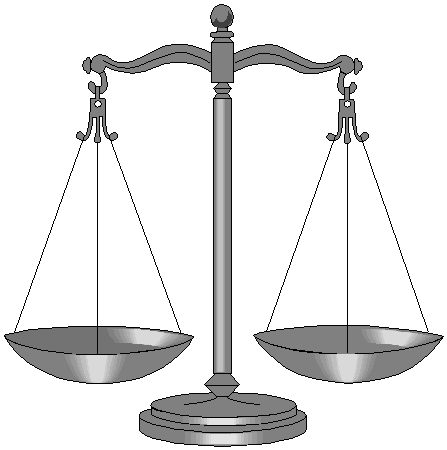
The employee is someone who performs work for an employer. The employee gets certain benefits and returns for performing this work, usually in the form of an agreed amount of money from the employer. There may be other forms of benefits like healthcare, paid leave from work etc. The nature and amount work as well as the benefits in return for work are usually laid out in the form of an agreement, or contract that is mutually agreed upon by both employee and employer. In an ideal situation, the employee would seek maximal benefits for a well-defined set of work or services rendered.
Source: sparklette.net
The employer is usually, but not always, an organization. The employer could also be a person. For example, I may get someone to chaffeur me around instead of driving the car myself. And in return for driving me around, I pay this person a certain amount of money every month. So in this example, the chaffeur is the employee while I am the employer. We see that the main concern for employers is maximal work done at minimal cost. Using the above example, I would, ideally, pay him a buck and have him on 24/7 stand-by, plus car wash & wax every morning. Now, some of you might be sniggering because although I've cited an extreme case, it sounds familiar enough.
Source: Eugene Wallingford
The role of the government in labour relations is to look after the welfare of the people it governs while allowing society to function without hinderance. Of course, the government has certain powers vested to create and enforce legislation on workplace relations. We will immediately realise that it is in the interest of both employees and employers to get the government "on their side". The main concern of any elected government is how it can stay in power. This concern does not apply to governments that do not have to account to its people (i.e. absolute monarchs, dictators, despots, election-riggers etc). Accountable governments, therefore, will strive to create an environment where employee rights are resepected, implement generous (i.e. low) corporate tax policies and have enough in its pockets to fund everyday running of the state so that everyone's happy and will vote for it in the next elections.
We'll look at employment contracts next...
We'll look at employment contracts next...
Saturday, January 26, 2008
Ventricular ectopics
Adrenaline-induced ventricular ectopics.

Public domain
Damn uncomfortable feeling.
I need a break from everything.
Public domain
Damn uncomfortable feeling.
I need a break from everything.
Tuesday, January 22, 2008
Girls (and boys) just wanna have fun
My mother says, "When you gonna live your life right?"
Oh, mother, dear,
We're not the fortunate ones,
And girls,
They wanna have fun.
Oh, mother, dear,
We're not the fortunate ones,
And girls,
They wanna have fun.
Someone passed me the YouTube link to a song from not-so-long ago.
As a pimply boy, I got teased quite a lot for listening to Cyndi Lauper's songs. Punk had arrived in Singapore a few years before. It was also the era of flashy clothes and Centrepoint Kids. Going to a "good" school, it wasn't easy being different from others, especially if that difference was perceived with a negative tint.

Photo: www.cyndilauper.com
I had an oppressive childhood and that is the main contributing factor to my liking for anything anti-establishment. The question that's constantly in my mind is, "Why can't you leave me alone to do my things?"
And I must add that the best thing that happened to me is being married to Wifey. I can get away with a lot of things with her. Heck, I even envision Faith dressing up like Cyndi Lauper when she grows up. Now THAT would be interesting...
Tuesday, January 08, 2008
Western rubble = Eastern treasure
"Niemand hat die Absicht, eine Mauer zu errichten!"
"No one has the intention to erect a wall!"
-Walter Ulbricht, leader of East Germany
June 15, 1961
Two months before construction of the Berlin Wall
"No one has the intention to erect a wall!"
-Walter Ulbricht, leader of East Germany
June 15, 1961
Two months before construction of the Berlin Wall
So 1984-ville has decided to install a piece of the Berlin Wall in one of its parks. It wasn't that long ago that Communism in Eastern Europe came to an end, along with it the Cold War and oppression of the common man. The Berlin Wall became a symbol of this oppression.
Erected in August 1961 by the East German communist government, under pressure from the Soviet Union, to stem the tide of defectors crossing into West Germany, it came to signify the attempt by rulers to control the ruled, keeping freedom out and forming the fences of a literal and figurative prison. An explicit shoot-to-kill policy was adopted by the East German government on anyone trying to flee westward and about 200 East Germans are known to have died for a chance at freedom.


A piece of history? Maybe. But art? Blood was shed over it. It is a symbol of how badly human beings treat one another. Communism as a political system might be in disfavour now but the threats to freedom remain. When you see kids skateboard past the wall, tell them about the blood and tears that used to bathe it.
Lest we forget.
Saturday, December 22, 2007
Winter solstice
So once again we are at the turning point of the year. The northern hemisphere is experiencing its longest night. The winter solstice falls on the thirteenth day of the eleventh month of the Chinese calendar (十一月十三日) this year.
It's strange that I should remember and mark this astronomical event every year. The quietness of a dark night appeals to me more than the noise and light of other occasions like Christmas or Chinese New Year. I can imagine a family reunited for dinner on the longest night of the year.

Image credit: baidu.com
Of course, it's quite nonsensical to talk about a long, dark winter's night while I live right smack on the Equator where the climate is perpetually hot and humid. Maybe that's why I find it mind-numbingly stifling here. The weather is a metaphor of the mindset here in 1984-ville. Every where I turn to, people go to the same malls for leisure. Everyone lives in perpetual fear of losing their jobs, or of not getting their yearly bonus. The conversation topics revolve around property prices, public and private transport taxes. The weather is hot, humid and nothing else. We wear the same kinds of clothes the whole year round. And every household overworks its System 4 Inverters.
Nobody looks up at the sky anymore. We are losing our individual and collective souls. When was the last time you saw a shooting star? Really...
Pause and think about what it means to be in-sync with your inner soul as you go about completing the last-minute shopping. What is it to be human?
I wish you peace.
It's strange that I should remember and mark this astronomical event every year. The quietness of a dark night appeals to me more than the noise and light of other occasions like Christmas or Chinese New Year. I can imagine a family reunited for dinner on the longest night of the year.
Image credit: baidu.com
Of course, it's quite nonsensical to talk about a long, dark winter's night while I live right smack on the Equator where the climate is perpetually hot and humid. Maybe that's why I find it mind-numbingly stifling here. The weather is a metaphor of the mindset here in 1984-ville. Every where I turn to, people go to the same malls for leisure. Everyone lives in perpetual fear of losing their jobs, or of not getting their yearly bonus. The conversation topics revolve around property prices, public and private transport taxes. The weather is hot, humid and nothing else. We wear the same kinds of clothes the whole year round. And every household overworks its System 4 Inverters.
Nobody looks up at the sky anymore. We are losing our individual and collective souls. When was the last time you saw a shooting star? Really...
Pause and think about what it means to be in-sync with your inner soul as you go about completing the last-minute shopping. What is it to be human?
I wish you peace.
Monday, December 03, 2007
Communication
You know, much of the conflict around the world arise from a lack of clear communication. Who was it who came up with a model of how ideas get perverted in transmission? He must have had too much time on his hands be a genius. The steps go:
1. Sender forms idea
2. Idea is coded intoan expletive about someone's parents a message output
3. Output is picked up by receiver
4. Receiver decodes message
5. Receiver translates decoded message into idea
6. Blood feud begins
or some sh*t like that. Should've paid attention in school.
Anyway, the original idea gets changed four times when the receiver eventually forms his own ideas about the idea. No wonder we all behave like deers without eyes.
Think I'll brush up English speech & grammar (yeah, all that SVO crap) and then maybe get a TESOL or CELTA certification beforeunleashing all my corrupting powers on unsuspecting fools helping poor kids learn English.
__________
 education, language
1. Sender forms idea
2. Idea is coded into
3. Output is picked up by receiver
4. Receiver decodes message
5. Receiver translates decoded message into idea
or some sh*t like that. Should've paid attention in school.
Anyway, the original idea gets changed four times when the receiver eventually forms his own ideas about the idea. No wonder we all behave like deers without eyes.
Think I'll brush up English speech & grammar (yeah, all that SVO crap) and then maybe get a TESOL or CELTA certification before
__________
education, language
Thursday, November 22, 2007
Please make sense
Read an article in the local rag about the rising trend of 1984-ville parents sending their children to international (private) instead of government schools. Apparently parents need approval from the government for their kids to attend private schools. The reason cited in the article was a need to promote cross-culture understanding. However in the same article, the writer noted that international schools have students from many countries and are more heterogenous than local schools. The environment is more child-friendly, catering even to kids with special needs.
I have only 3 rhetorical questions:
1. Can someone please make sense here?
2. Why don't we just admit that the reason for not allowing local children into what are essentially foreign schools is so we can brain-wash them early?
3. Who says I need approval for doing what I want to do for my kids?
Good behavior doesn't allow me to express myself in Hokkien here.
I have only 3 rhetorical questions:
1. Can someone please make sense here?
2. Why don't we just admit that the reason for not allowing local children into what are essentially foreign schools is so we can brain-wash them early?
3. Who says I need approval for doing what I want to do for my kids?
Good behavior doesn't allow me to express myself in Hokkien here.
Wednesday, October 10, 2007
Losing sight of the reason
Sometimes we lose sight of why we do certain things. For example, people form organized groups for a purpose. But very often it feels like the organization exists as an end to itself and not for its stated purpose.
We will form a group known as XXXX because...
How you complete the above statement will determine if your group has a reason to exist.
We will form a group known as XXXX because...
How you complete the above statement will determine if your group has a reason to exist.
Thursday, September 20, 2007
The beginning and end of summer

Source: The Internet Encyclopedia of Science
The Sun crosses the Equator in a few days' time on its southward journey. September 23rd to be precise. Actually, to be strictly correct, the Sun doesn't cross the Equator. It's more like the Earth reaching a portion of her orbit around the Sun such that parts of the Earth's surface around the Equatorial region would face the Sun directly at noon on September 23rd. Those who spoke Latin named this day Equinox, from aequus (equal), nox (night), meaning there would be equal number of day and night hours in a single day.
In another three months the Chinese will be celebrating the end of another year. They call that winter solstice in the northern hemisphere. Longer nights ahead.
Of course, things are reversed in the southern hemisphere.
On a more practical side, it also means that the sun will no longer shine directly into my living room. Cooler daytime temperatures are definitely welcomed.
_______________
Friday, December 22, 2006
Winter solstice

Source: Google
Popularly known as 冬至 among the Chinese community. Legend has it that the birth date of Jesus was moved to 25th December to coincide with winter solstice - the shortest day, after which the sun was "reborn" and daylight hours become longer.
The marking of 冬至 as a holiday was recorded as far back as the Spring-Autumn (春秋) Period (722-481 BC). The Book of Later Han (后汉书) records, "冬至前后,君子安身静体,百官绝事,不听政,择吉辰而后省事." Roughly translated as, "the time around 冬至, the emperor rested and calmed his body, the imperial palace refused to work, the imperial sessions ceased, auspicious dates were selected."
So the concept of "clear leave" is not that modern after all. However, unlike modern workaholics, the annual leave was mandated and presumably enforced. Imagine being forced to go on leave on the pain of death or torture, or bosses being put under the guillotine for not letting staff go on leave!
Subscribe to:
Posts (Atom)