Here I am, sitting outside the Central Library along Bras Basah Road, taking a rest while the sound of the city hums in the background. A fire alarm goes off and pierces my consciousness, but nobody around me seems to react to it.
I realize the sensorial overload that city dwellers are subjected to on a daily basis. It's not a wonder that our senses become blunt. Having to handle the assault on the brain does not allow children to develop any kind of meaningful attention span.
Back in the benign 80s and early 90s, the ability to multi-task was lauded in schools and by parents looking to give their kids an edge over others. And not being able to do so was taken as a character flaw.
Is it any wonder that a generation of Singaporeans was raised with attention deficit?
Showing posts with label Health. Show all posts
Showing posts with label Health. Show all posts
Wednesday, October 15, 2014


Saturday, January 26, 2008
Ventricular ectopics
Adrenaline-induced ventricular ectopics.

Public domain
Damn uncomfortable feeling.
I need a break from everything.
Public domain
Damn uncomfortable feeling.
I need a break from everything.
Wednesday, December 19, 2007
Lasik (Part 4), or The Baggage from My Past
I live in a place with the highst rate of myopia in the world. Myo-what? That's the medical term for short-sightedness. Most of my friends will agree with me that it is very annoying to have a pair of spectacles perching on your nose, without which you'd have to grope carefully in order not to trip over things while walking. Being myopic is more of a psychological scar than an everyday inconvenience for me. The reason I say this is because of the circumstance that made me short-sighted.
I was born to parents who did not need to wear glasses. My mum is not myopic now although she is beginning to develop long-sightedness due to old age. This condition results in her not being able to see things clearly at a close range. Think of it as the opposite of myopia. But I am digressing.

Photo credit: www.freephoto1.com
After a tempestuous relationship, my parents separated when I was barely learning how to control my piss. Anyway, I was put under the care of my maternal grandmother. Now, as it turns out, my mum was an adopted child so there isn't any blood relation between her and granny. This is an important point, as we shall see later. The other significant thing to note is that my granny's biological sons are all severely myopic.
Effectively, I was put into an environment where short-sightedness was the norm. I was also made to read textbooks over long hours under a dim fluorescent light bulb. The first sign of failing eye-sight appeared when I turned 10 years of age. I found that I couldn't read the service numbers of public buses until they came right up to the bus stop. I remember a funny experience with a friend of mine who also had problems with his eyesight. We had missed a bus because we couldn't read the number until it was too late to flag. Yes, bus drivers were and still are an impatient lot. So we devised a plan. You know how it is with 10-year-old boys, they come up with the most ingenious of plots. My friend stationed himself about 50 metres ahead of the bus stop and he did the number spotting, waving to me when the right bus approached. I then had ample time to flag the bus while he would make a mad dash back to the bus stop.
So that was my first step into the world of myopia. I was definitely coerced into it. I remember the physical abuse that I received if I did not do well in school. One of my uncle even set his own test papers for me on a weekly basis, giving me a good thrashing when I got any mistake. Once he returned from work while I was watching TV. He promptly interrogated me on why I was not studying. I got another beating with the warning to "make sure that you are studying when I return home." All that abuse was witnessed by other members of the household. No one intervened.
There is only so much that a yound child can take before he breaks and does one of two things: run away or allow his will to be broken. For good or bad, I chose to conform to expectations, putting in countless hours of revision and reading. All the while under unsuitable lighting conditions.
My short-sightedness hangs like a ghost from the past, a reminder of the unhappy days and how I was robbed of my birthright. I have no genetic pre-disposition towards myopia but I was forced to abuse my eyes to point of failure.
Now that I'm a father of two beautiful daughters, I pray desperately everyday that they will not have to wear glasses when they start going to school. Because when I put on my glasses every morning, I am reminded of the emotional baggage that flawed care-givers placed on me so many years ago.
I was born to parents who did not need to wear glasses. My mum is not myopic now although she is beginning to develop long-sightedness due to old age. This condition results in her not being able to see things clearly at a close range. Think of it as the opposite of myopia. But I am digressing.
Photo credit: www.freephoto1.com
After a tempestuous relationship, my parents separated when I was barely learning how to control my piss. Anyway, I was put under the care of my maternal grandmother. Now, as it turns out, my mum was an adopted child so there isn't any blood relation between her and granny. This is an important point, as we shall see later. The other significant thing to note is that my granny's biological sons are all severely myopic.
Effectively, I was put into an environment where short-sightedness was the norm. I was also made to read textbooks over long hours under a dim fluorescent light bulb. The first sign of failing eye-sight appeared when I turned 10 years of age. I found that I couldn't read the service numbers of public buses until they came right up to the bus stop. I remember a funny experience with a friend of mine who also had problems with his eyesight. We had missed a bus because we couldn't read the number until it was too late to flag. Yes, bus drivers were and still are an impatient lot. So we devised a plan. You know how it is with 10-year-old boys, they come up with the most ingenious of plots. My friend stationed himself about 50 metres ahead of the bus stop and he did the number spotting, waving to me when the right bus approached. I then had ample time to flag the bus while he would make a mad dash back to the bus stop.
So that was my first step into the world of myopia. I was definitely coerced into it. I remember the physical abuse that I received if I did not do well in school. One of my uncle even set his own test papers for me on a weekly basis, giving me a good thrashing when I got any mistake. Once he returned from work while I was watching TV. He promptly interrogated me on why I was not studying. I got another beating with the warning to "make sure that you are studying when I return home." All that abuse was witnessed by other members of the household. No one intervened.
There is only so much that a yound child can take before he breaks and does one of two things: run away or allow his will to be broken. For good or bad, I chose to conform to expectations, putting in countless hours of revision and reading. All the while under unsuitable lighting conditions.
My short-sightedness hangs like a ghost from the past, a reminder of the unhappy days and how I was robbed of my birthright. I have no genetic pre-disposition towards myopia but I was forced to abuse my eyes to point of failure.
Now that I'm a father of two beautiful daughters, I pray desperately everyday that they will not have to wear glasses when they start going to school. Because when I put on my glasses every morning, I am reminded of the emotional baggage that flawed care-givers placed on me so many years ago.
__________
Technorati: myopia, health, lasik
Saturday, December 15, 2007
Stress
We experience mental stress generally when we perceive that the demands of aspects of our lives overwhelm our capabilities to handle such demands. All of us have experienced some form of stress in our lives, some are better able to handle it, others need external intervention.

Hallucination is a symptom of extreme stress
Photo credit: www.cattlerange.com
We are probably familiar with the general stages of stress. They are, in order of severity:
1. Awareness. This happens when we become aware of the threat to our well-being and this is usually associated with a sudden increase in pulse rate. In most people, this is the shortest stage of stress and they eventually move on to next stage.
2. Coping. The typical response after we become aware of the threat to our well-being is, of course, to try to get rid of the problem or to find ways of living with the problem such that it does as little damage as possible. We know that coping mechanisms cannot function indefinitely as it depletes our resources. When the threat eventually outlasts our coping mechanisms, we move on to the third and most serious stage.
3. Exhaustion. When our coping mechanisms are overwhelmed, our body can no longer maintain normal functions. This results in our organ systems not performing the right things. For example, improper organ functioning may be manifested as stomach ulcers, heart attacks or insomnia. The most serious consquence is, of course, death from these manifestations.
There is considerable overlap among the three general stages. For example, a person may experience insomnia while successfully resolving the problem. My experience with the stages of stress is typical. I remember experiencing frequent diarrhoea during the school examinations, especially before and after tough papers.
The most insidious way by which stress levels build up in most working class city-dwellers is presenteeism. We ignore stress signals to carry on working, always striving for one more hour, one more page or one more deal. Employees & employers alike are equally guilty of promoting such health-destroying behaviour because going on sick leave is generally frowned upon. The subconscious message is that a person who fails to cope with stress has a lesser moral character or questionable work ethic.
There is always a choice to walk away from work when the alarm bells go off. Workers need to be empowered not just with legislative protection but also with knowledge of how to recognise stress levels and the available resources to help them cope.
__________
 stress health
Hallucination is a symptom of extreme stress
Photo credit: www.cattlerange.com
We are probably familiar with the general stages of stress. They are, in order of severity:
1. Awareness. This happens when we become aware of the threat to our well-being and this is usually associated with a sudden increase in pulse rate. In most people, this is the shortest stage of stress and they eventually move on to next stage.
2. Coping. The typical response after we become aware of the threat to our well-being is, of course, to try to get rid of the problem or to find ways of living with the problem such that it does as little damage as possible. We know that coping mechanisms cannot function indefinitely as it depletes our resources. When the threat eventually outlasts our coping mechanisms, we move on to the third and most serious stage.
3. Exhaustion. When our coping mechanisms are overwhelmed, our body can no longer maintain normal functions. This results in our organ systems not performing the right things. For example, improper organ functioning may be manifested as stomach ulcers, heart attacks or insomnia. The most serious consquence is, of course, death from these manifestations.
There is considerable overlap among the three general stages. For example, a person may experience insomnia while successfully resolving the problem. My experience with the stages of stress is typical. I remember experiencing frequent diarrhoea during the school examinations, especially before and after tough papers.
The most insidious way by which stress levels build up in most working class city-dwellers is presenteeism. We ignore stress signals to carry on working, always striving for one more hour, one more page or one more deal. Employees & employers alike are equally guilty of promoting such health-destroying behaviour because going on sick leave is generally frowned upon. The subconscious message is that a person who fails to cope with stress has a lesser moral character or questionable work ethic.
There is always a choice to walk away from work when the alarm bells go off. Workers need to be empowered not just with legislative protection but also with knowledge of how to recognise stress levels and the available resources to help them cope.
__________
stress health
Tuesday, March 20, 2007
HFMD
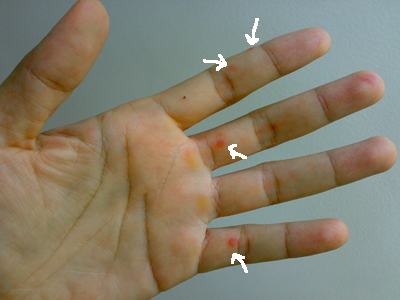
Looking like I had too much of paintball fun. Not to mention the worst pharyngitis of my whole life. Drinking plain water feels like scrubbing the back of my throat with sand paper.
Just great.
Friday, December 02, 2005
thrombotic thrombocytopenic purpura (updated)

It's never easy facing death and almost taboo to talk about it after it happens but facing up to unknowns and uncomfortable issues is one of the ways we overcome.
mrbrown has learnt that la idler died from an underlying condition that resulted in thrombotic thrombocytopenic purpura or TTP.
Just what does that long medical term means? Essentially it describes a syndrome and not the underlying disease. A syndrome is a host of signs and/or symptoms, when taken together sometimes points to an underlying cause, sometimes we don't know what is happening. And when the medical establishment doesn't know what is the underlying cause, the prefix idiopathic is added to the term. Hence if a medical reports states that the patient had idiopathic TTP or idiopathic high blood pressure, it simply means we don't know what's causing the TTP or high BP respectively.
Thrombotic comes from the word thrombus, the latter meaning blood clot. As some may know, blood platelets is one of the important component involved in the complex process of clotting. Another name for platelet is thrombocyte.
Thrombocytopenic means a decreased concentration of platelets, making formation of blood clots difficult and sometimes a person who is thrombocytopenic will experience unexplained bleeding. And why would a normal person bleed? Well, what is not widely known is that cells in our bodies breakdown regularly and repairs are an ongoing process. So the cells in a normal person walking around are being continually replaced, ensuring that he/she runs around without problems.
But didn't I just mentioned that thrombosis means clotting? So isn't thrombotic thrombocytopenic an oxymoron, given that a person with low platelet count has problems getting the blood to clot? Well, it seems that the initial unexplained thrombosis uses up so much platelets that there isn't enough to go around to repair other places that need to clot. Therefore, in TTP the patient's blood clots and bleeds at inappropriate places.
Purpura simply means bruising.
Taken together, TTP means random, uncontrolled clotting with low platelet counts and bruising.
A person with TTP usually presents with fever, headache, malaise (general sense of feeling unwell) and diarrhoea. Brusing and small bleeds also occurs in the gums and nose. Investigations would reveal a low platelet count. These are also the usual signs/symptoms in dengue patients and it is only by testing for the presence of anti-dengue antibodies can we confirm that the patient has contracted dengue or not. I suspect that the initial management for suspected TTP is similar for dengue hemorraghic fever. TTP is a rare disorder, with about 1 in 1-3 million cases annually although women seemed to be affected more than men. TTP may result from an inherited condition or it may be acquired. The actual causes are possibly many.
See this link for a better explanation.
Whatever the case may be. Rest in peace, Sondra.
Update
For those with access to scientific papers here are some useful references...
Yarranton H, Machin SJ. 2003. CURRENT OPINION IN NEUROLOGY 16:367-373
Richards A, Goodship JA, Goodship THJ. 2002. CURRENT OPINION IN NEPHROLOGY AND HYPERTENSION 11:431-435
Tsai HM, Lian ECY. 1998. NEW ENGLAND JOURNAL OF MEDICINE 339:1585-1594
Egerman RS, Witlin AG, Friedman SA, Sibai BM. 1996. AMERICAN JOURNAL OF OBSTETRICS AND GYNECOLOGY 175:950-956
Technorati tags: Thrombotic Thrombocytopenic Purpura, Medical, Blood Disorder
Tuesday, November 15, 2005
of health priorities...

Image from Google search
Researchers have made a breakthrough discovery in the fight against malaria. However in the light of differing media priority, especially in this region, I don't think it'll be given much publicity compared to the potential H5N1 (avian flu) outbreak or even the lingering aftermath of SARS. All of which got me thinking about the priorities we put in healthcare.
Let's do the figures here:
Malaria
No. of people infected annually - est. 350 to 500 million
No. of deaths annually - est. 1 million
H5N1
No. of people infected so far - est. 120
No. of deaths so far - over 60
Maybe malaria may sound too dramatic to you. Ok, let's talk about something basic that we all take for granted. The lack of access to safe drinking water & diarrheal diseases resulting from drinking contaminated water.
No. of children dying from diarrhea annually - est. 470 million
No. of people without access to potable water - est. 1.1 billion
It seems almost unheard of, in my society, for people to die from diarrhea but it happens to a child every 15 seconds.
Potable water. It's something which 1 in 5 people on earth can only dream of and it's something we can do a part in, no matter how big or small.
Technorati tags: medical, potable water, malaria, fungi
Wednesday, October 26, 2005
Thimerosal

Photo linked from CERHR website
Thimerosal, also known as thiomersal. Used as a bactericidial agent, infamously in many vaccine formulations. Note the 'Hg' symbol in the above diagram. That's mercury. It poisons the body. People of all ages are susceptible to it but the brains of children especially so because the blood-brain barrier is not as developed in the early years of infancy thus allowing more mercury to be accumulated in it. Like how salmons and large fish do.
A controversial story from Rolling Stone magazine posted online in June this year reported about the alleged dark and sordid side of so-called "scientific research".
An excerpt from the story:
...the company continued to promote thimerosal as "nontoxic" and also incorporated it into topical disinfectants. In 1977, ten babies at a Toronto hospital died when an antiseptic preserved with thimerosal was dabbed onto their umbilical cords.
The resulting controversy garnered a response from the writer and editors, who wrote, among other things:
"Science," as one doctor in our story insisted, "is best left to scientists." But when the scientists fail to do their job, resorting to closed-door meetings and rigged studies, others in society have not only a right but a moral obligation to question their work.
Link to the response
Having barely scratched the surface of scientific research, I cannot judge the academic merits of other scientists but from what I've gleaned from attending conferences and talking to big shots, one thing is certain: BIG money is at stake and I'm not talking just about sums enough to buy condo's and COEs. These figures dwarf the GDPs of many small countries.
We all know what happens when $$ is at stake...
Monday, October 24, 2005
Infectious Diseases Act (Chapter 137)
Here's the deal on what is required by law in Singapore, regarding vaccinating children (taken from Singapore Statues Online):
Infectious Diseases Act (Chapter 137), Section 46(1):
The parent or guardian of every child in Singapore shall ensure that the child is vaccinated against the diseases set out in the Fourth Schedule.
And the Fourth Schedule:
Diseases against which a child is to be vaccinated
(1) Diphtheria.
(2) Measles.
So it is possible to request your physician to have diphteria-only and measles-only vaccines given to your child. There is no compulsion to use only DTP, DTaP or MMR. There is also no compulsion to use vaccines with thimerosal. By the way, vaccines that guard against more than one pathogen are sometimes known as multi-valent vaccines while those which guard against only one disease are known as mono-valent vaccines.
I am now trying to find out if there is a time frame by which parents or guardians must comply with this legislation. Currently the practice is to give DTP at 3 months and MMR at 15 months. Perhaps it is possible to delay giving a child these vaccines until a year before school-going age, 4 years for kindergarten and 6 years for primary school, when the child's body and immune system are stronger and more settled.
Infectious Diseases Act (Chapter 137), Section 46(1):
The parent or guardian of every child in Singapore shall ensure that the child is vaccinated against the diseases set out in the Fourth Schedule.
And the Fourth Schedule:
Diseases against which a child is to be vaccinated
(1) Diphtheria.
(2) Measles.
So it is possible to request your physician to have diphteria-only and measles-only vaccines given to your child. There is no compulsion to use only DTP, DTaP or MMR. There is also no compulsion to use vaccines with thimerosal. By the way, vaccines that guard against more than one pathogen are sometimes known as multi-valent vaccines while those which guard against only one disease are known as mono-valent vaccines.
I am now trying to find out if there is a time frame by which parents or guardians must comply with this legislation. Currently the practice is to give DTP at 3 months and MMR at 15 months. Perhaps it is possible to delay giving a child these vaccines until a year before school-going age, 4 years for kindergarten and 6 years for primary school, when the child's body and immune system are stronger and more settled.
Vaccination schedule for children in Singapore
Age - Vaccine given
At birth - BCG & Hepatitis B
1 month - Hep B (2nd dose)
3 months - DTP (i.e diptheria/tetanus/pertussis) & Polio
4 months - DTP & Polio (2nd dose)
5 months - DTP & Polio (3rd dose)
6 months - Hep B (3rd dose)
15 months - MMR (i.e measles/mumps/rubella)
18 months - DTP & Polio (booster dose)
6 years - DT (without pertussis) & Polio (2nd booster)
12 years - DT, Polio (3rd booster) & MMR (2nd dose)
Now, here are some prominent problems associated with these vaccines:
Hepatitis B
In 1998, France withdrew the Hep B vaccine because of linkages to multiple sclerosis as well as other immuno- and neurological problems developing in children who received it.
DTP
The DTP vaccine was taken off the shelves in Japan during the 1970s, again, because of adverse reactions to the pertussis component in DTP. A milder form of the vaccine, DTaP was developed instead because the original pertussis component was too strong and caused severe reactions in people who received DTP. The Kitasato Institute states that "Whole-cell vaccine (DTP) is does(sic) not recommended for use in the Japan." DTaP was introduced in the US only in the 1990s. “aP” means “acellular pertussis”.
MMR
There is a suggested linkage between MMR and autism. This is currently a hotly debated topic with politics and egos being thrown around. Watch this space, it's going to be news.
Polio
The polio vaccine has 2 forms, one given by injection, the other orally (i.e drinking it). The oral form has been known to cause polio in some people instead of protecting them.
The issue of thimerosal or mercury in vaccines
Most of these vaccines are produced in vials and in volumes suitable for multiple doses per vial. Now, the problem with such an arrangement was the repeated introduction of the needles (albeit a different needle each time) into the vials, thus increasing the likelihood of contamination. So to overcome this problem of contamination, a chemical is put into such vaccines. This chemical is thimerosal, which is a form of mercury. So everytime a shot given, mercury is injected into the body along with the vaccine.
At birth - BCG & Hepatitis B
1 month - Hep B (2nd dose)
3 months - DTP (i.e diptheria/tetanus/pertussis) & Polio
4 months - DTP & Polio (2nd dose)
5 months - DTP & Polio (3rd dose)
6 months - Hep B (3rd dose)
15 months - MMR (i.e measles/mumps/rubella)
18 months - DTP & Polio (booster dose)
6 years - DT (without pertussis) & Polio (2nd booster)
12 years - DT, Polio (3rd booster) & MMR (2nd dose)
Now, here are some prominent problems associated with these vaccines:
Hepatitis B
In 1998, France withdrew the Hep B vaccine because of linkages to multiple sclerosis as well as other immuno- and neurological problems developing in children who received it.
DTP
The DTP vaccine was taken off the shelves in Japan during the 1970s, again, because of adverse reactions to the pertussis component in DTP. A milder form of the vaccine, DTaP was developed instead because the original pertussis component was too strong and caused severe reactions in people who received DTP. The Kitasato Institute states that "Whole-cell vaccine (DTP) is does(sic) not recommended for use in the Japan." DTaP was introduced in the US only in the 1990s. “aP” means “acellular pertussis”.
MMR
There is a suggested linkage between MMR and autism. This is currently a hotly debated topic with politics and egos being thrown around. Watch this space, it's going to be news.
Polio
The polio vaccine has 2 forms, one given by injection, the other orally (i.e drinking it). The oral form has been known to cause polio in some people instead of protecting them.
The issue of thimerosal or mercury in vaccines
Most of these vaccines are produced in vials and in volumes suitable for multiple doses per vial. Now, the problem with such an arrangement was the repeated introduction of the needles (albeit a different needle each time) into the vials, thus increasing the likelihood of contamination. So to overcome this problem of contamination, a chemical is put into such vaccines. This chemical is thimerosal, which is a form of mercury. So everytime a shot given, mercury is injected into the body along with the vaccine.
Are vaccines safe for children?
The reasons for asking this question are:
1. Too many of my friends are having children with Autism Spectrum Disorders (ASD or commonly known as autism).
2. My daughter is about to be born this November and will be expected to go through a battery of at least 13 doses of vaccines against 9 different diseases.
Get this book for a thought-provoking read.

What started out as a casual remark by a friend about the phenomenon of more and more children being diagnosed with ASD started a chain of literature search and email queries to health authorities here. I've also taken to reading instruction leaflets that come along with all OTC as well as prescription-only drugs. Let's face it, most of us, even those in the practice, would simply throw away these leaflets and just either follow DIMS (Drug Index of Malaysia & Singapore, essentially a guide to drugs published by drug companies) or what's conventionally being dispensed by others. A case of following the majority.
Here are some disturbing issues yet to be resolved:
1. The long-term effects of vaccines are rarely studied. Most pre-market release trials observe test subjects over a period of a few days or weeks for short term effects like fever, swelling of injection areas. No one knows what vaccines do to children over months and years.
2. Heavy metals such as mercury and aluminium are often used as preservatives in quite a number of vaccines. We know for a fact that minute amounts of heavy metals do severe damage to the body and that these heavy metals, unlike some others like iron and zinc, have no known beneficial effects on the body. Why then, in this age where even the tiniest amounts of mercury in salmon and big fishes are considered harmful, are we knowingly putting these metals into infants?
3. The principle of vaccination is basically putting the pathogens into the body, in a controlled manner, to stimulate the immune response. Are the levels of pathogens safe?
Heavy questions for all concerned parents indeed.
1. Too many of my friends are having children with Autism Spectrum Disorders (ASD or commonly known as autism).
2. My daughter is about to be born this November and will be expected to go through a battery of at least 13 doses of vaccines against 9 different diseases.
Get this book for a thought-provoking read.
What started out as a casual remark by a friend about the phenomenon of more and more children being diagnosed with ASD started a chain of literature search and email queries to health authorities here. I've also taken to reading instruction leaflets that come along with all OTC as well as prescription-only drugs. Let's face it, most of us, even those in the practice, would simply throw away these leaflets and just either follow DIMS (Drug Index of Malaysia & Singapore, essentially a guide to drugs published by drug companies) or what's conventionally being dispensed by others. A case of following the majority.
Here are some disturbing issues yet to be resolved:
1. The long-term effects of vaccines are rarely studied. Most pre-market release trials observe test subjects over a period of a few days or weeks for short term effects like fever, swelling of injection areas. No one knows what vaccines do to children over months and years.
2. Heavy metals such as mercury and aluminium are often used as preservatives in quite a number of vaccines. We know for a fact that minute amounts of heavy metals do severe damage to the body and that these heavy metals, unlike some others like iron and zinc, have no known beneficial effects on the body. Why then, in this age where even the tiniest amounts of mercury in salmon and big fishes are considered harmful, are we knowingly putting these metals into infants?
3. The principle of vaccination is basically putting the pathogens into the body, in a controlled manner, to stimulate the immune response. Are the levels of pathogens safe?
Heavy questions for all concerned parents indeed.
Subscribe to:
Posts (Atom)