Tuesday, April 08, 2008

The sweeping tide


Australia got the ball rolling before 2008 when it booted out the incumbent government in November 2007 and welcomed Kevin Rudd, a Mandarin-speaking former diplomat to China, as the new Prime Minister. The tide of change has not stopped since and democracies, real or otherwise, across the world saw sweeping changes in their governments.
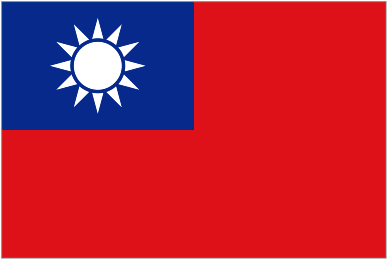


Taiwan was next with the opposition Kuomintang (KMT) coming home to a landslide over the Democratic People's Party (DPP) in the Legislative Yuan, or Assembly, elections, held in January 2008. The DPP, in power since 2000, is led by outgoing President Chan Shui-bian, who has the habit using off-coloured phrases occasionally. The change in government was completed when Ma Ying-jeou of the KMT thrashed Frank Hsieh of the DPP in Presidential elections two months later.



Pakistan took its turn on the political centre stage when, in February, the PMLQ party of President Pevez Musharraf was almost booted out of the legislative body by the Pakistan People's Party (PPP), formerly headed by the recently-assasinated Benazir Bhutto. It's ironic that Musharraf was described by George Bush as his friend and ally because Musharraf came to power through a 1999 military coup and had sacked and jailed most of the independent judiciary in Pakistan, especially after the former Chief Justice Iftikhar Chaudhry declared the continued Presidency of Musharraf unconstitutional. Well, the good news is that Chaudhry has been freed and reinstatement is pending approval by the PPP government.
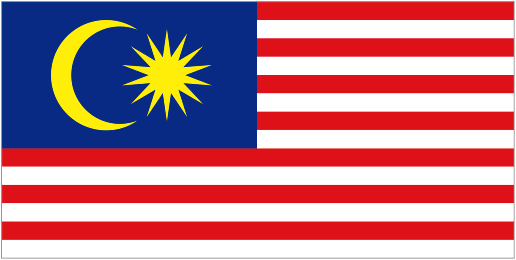


Political action then moved to Malaysia, where the seemingly strong National Front government of Abdullah Badawi was embarrased by a hotch-potch of small opposition parties, independents and a political blogger, which not only denied the NF a two-thirds majority in the federal legislative, Dewan Rakyat, (Lower House of Parliament) for the first time since independence in 1957, but also grabbed 5 State governments out of 12. Abdullah's position in his own party is under severe scrutiny. With internal party elections coming up later this year, there is an ever-growing call for his blood. However the most anticipated outcome of this watershed election is the return of former Deputy Prime Minister, Anwar Ibrahim, who was arbitrarily removed from power and jailed after a very pubic spat with former PM Mahathir over the handling of the 1997 Asian financial crisis. In fact, this election was called early because Anwar remained ineligible to contest for a certain period of time after release from jail. Anwar's wife has said she will step down from her seat in parliament to create a by-election for Anwar after he becomes eligible to contest.
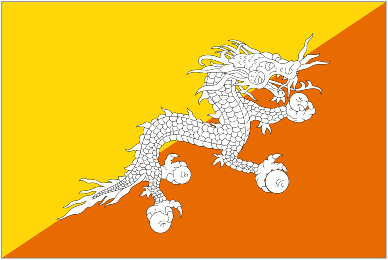


From the hot and humid tropics, the world's attention turned to the isolated Himalayan Kingdom of Bhutan, the land of the Thunder Dragon. The King of Bhutan called for a change from absolute monarchy to democracy. This despite having the respect and admiration of most Bhutanese. Sometimes one really wonders if this really is the benevolent ruler found only in fiction. This is the very same king who imposed a total smoking ban in the country. And he ordered the statisticians to measure the progress of the people in terms of a "happiness index" instead of per capita income, GDP or other traditional methods of economic progress. Shangri-La, anyone?
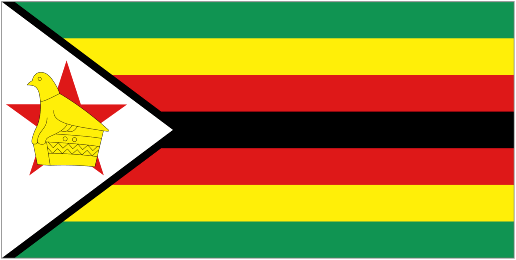


Zimbabwe came up for the electoral process next on 29 March. Unfortunately, Robert Mugabe, the incumbent president, and his Zimbabwe African National Union - Patriotic Front government (Zanu-PF), in power since independence in 1980, has decided not to release the results of elections. As of the time of this writing, Zimbabweans are still awaiting official results to the legislative and presidential offices. Informal results collated by the oppostion Movement for Democractic Change (MDC) has indicated opposition wins in both. The police authority, no doubt controlled closely by Zanu-PF, has physically stopped MDC lawyers from going to the courts to petition for the release of official results. One can only wonder how long more Mugabe and his party wish to hang on to power.

Up next? South Korea, Nepal, Italy, Serbia, Cambodia, New Zealand and the big one - the United States, where the Most Powerful Person in the World could be a black or a woman.


Source: www.orstudents.org
Source of all flag images: www.flags.net


For once, the action-packed news does not involve men chasing or hitting a ball, running around a rubber mat, pounding one another to bits, driving noisy, climate-changing cars at 300mph or trying to grab some stupid flame torch making its way around the world.

Oh, and to dictators around thew world, I hope you sleep well tonight...

Monday, April 07, 2008

The Miracle Mile

Four A.M. We ran the miracle mile
"You Get What You Give" - The New Radicals

No longer conscious of my movement, I discovered a new unity with nature. I had found a new source of power and beauty, a source I never dreamt existed.
-Sir Roger Bannister


Source: Hulton Archive


It used to be that I was chasing a sub-four-minute mile in school. Hoping to do my own version of the Roger Bannister run on May 6, 1954. I never did it and the experience mirrored my life off the track - mostly bitter but crucial for getting through life and dealing with disappointments.

Two decades and many ectopic beats later, every mile I finish, no matter how slow, is a miracle. Thank You, God, for giving me a ticker that still ticks.

Thursday, April 03, 2008

Research and stuffiness


Copyright: ConcreteBob Software


Just to prove that Nobel laureates are regular joes...

H. pylori research lab

You can't deviate that far from normality with a stuffed Norwegian rat as mascot

Try the gastroman game, great fun for the final year surgery spot.

Monday, March 31, 2008

Things and stuff

It's been rather crazy over the last 6 weeks, getting swamped with work, mostly resulting from workplace incompetency and breaching of job scope. The work culture in 1984-ville is very bad. There is no effective legislation protecting employees and everyone is expected to work beyond 40 hours a week in addition to doing things that are outside of the job scope. Employers often use this culture to slip sneaky clauses into the terms of employment. Things like "...and any other matters that the employer may require the employee to perform." Clauses like that effectively give employers unfair advantage and make employees' job scope arbitrary. And employee-employer contracts are largely unregulated by legislation, so they are essentially private agreements between two parties, meaning the outcomes of disputes are decided in civil courts.


Photo: Alemeda Labor Council

Almost all of my colleagues accept this unfair and unequal labour relationship, perhaps for fear of breaking their rice bowl (or bread basket, if you aren't into rice). Anyone agitating for an improvement in work conditions is seen as rocking the boat. The thing is, employer-employee relationship is really very simple. In any industrial relation, you have three main components - employer, employee and government. With knowledge, you'll have a better idea of what you're getting yourself into before you sign on the dotted line.

Let's take a look at each party of a typical industrial relation in the modern world.


Public Domain

The employee is someone who performs work for an employer. The employee gets certain benefits and returns for performing this work, usually in the form of an agreed amount of money from the employer. There may be other forms of benefits like healthcare, paid leave from work etc. The nature and amount work as well as the benefits in return for work are usually laid out in the form of an agreement, or contract that is mutually agreed upon by both employee and employer. In an ideal situation, the employee would seek maximal benefits for a well-defined set of work or services rendered.


Source: sparklette.net

The employer is usually, but not always, an organization. The employer could also be a person. For example, I may get someone to chaffeur me around instead of driving the car myself. And in return for driving me around, I pay this person a certain amount of money every month. So in this example, the chaffeur is the employee while I am the employer. We see that the main concern for employers is maximal work done at minimal cost. Using the above example, I would, ideally, pay him a buck and have him on 24/7 stand-by, plus car wash & wax every morning. Now, some of you might be sniggering because although I've cited an extreme case, it sounds familiar enough.


Source: Eugene Wallingford

The role of the government in labour relations is to look after the welfare of the people it governs while allowing society to function without hinderance. Of course, the government has certain powers vested to create and enforce legislation on workplace relations. We will immediately realise that it is in the interest of both employees and employers to get the government "on their side". The main concern of any elected government is how it can stay in power. This concern does not apply to governments that do not have to account to its people (i.e. absolute monarchs, dictators, despots, election-riggers etc). Accountable governments, therefore, will strive to create an environment where employee rights are resepected, implement generous (i.e. low) corporate tax policies and have enough in its pockets to fund everyday running of the state so that everyone's happy and will vote for it in the next elections.

We'll look at employment contracts next...

Wednesday, February 13, 2008

Change (or not)

So we're all waiting with bated breath. While the global balance of power slowly shifts from the West to BRICs, we may see a non-White or female assuming the mantle of Most Powerful Person in the world.


Source: seattlepi.com

Land of the Free and Home of the Brave.

Indeed...